Becoming a doctor is a dream for thousands of students across India. Every year, lakhs of candidates appear for NEET with the hope of securing an MBBS seat in a reputed medical college. However, apart from preparing for the entrance exam, students and parents must also understand the MBBS admission cost in India before starting the admission process.
The cost of pursuing MBBS can vary significantly depending on whether a student gets admission in a government medical college, a private medical college, a deemed university, or through management quota. Many families focus only on tuition fees and often overlook hostel charges, mess fees, security deposits, counselling expenses, and other hidden costs.
If you are planning for MBBS Admission 2026 After NEET, this guide will help you understand the complete fee structure, additional expenses, and financial planning required for medical education in India.
What Is the MBBS Admission Cost in India?
The MBBS admission cost in India depends on several factors, including the type of college, admission quota, location, and state regulations. Government medical colleges are highly affordable, while private and deemed universities may require a significantly higher investment.
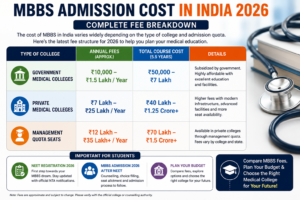
According to recent admission data, government medical colleges generally charge between ₹10,000 and ₹1.5 lakh annually, whereas private medical colleges can charge anywhere from ₹7 lakh to ₹25 lakh per year. Deemed universities and NRI quota seats may cost even more. Recent counselling reports indicate that the total cost of an MBBS degree can range from less than ₹1 lakh in some government institutions to more than ₹1 crore in private and deemed universities.
Understanding the MBBS admission cost in India in advance helps students make better decisions during counselling and avoid financial surprises later.
MBBS Admission 2026 After NEET: What Happens Next?
For students aiming for MBBS Admission 2026 After NEET, qualifying the examination is only the first step. After the result is declared, candidates must participate in counselling conducted by the Medical Counselling Committee (MCC) or respective state counselling authorities.
The admission process usually includes:
- NEET result declaration
- Counselling registration
- Choice filling and locking
- Seat allotment
- Document verification
- College reporting
The final MBBS admission cost in India will depend on the college allotted during counselling. Students should evaluate fee structures before locking their choices because tuition fees can vary drastically from one institution to another. NEET qualification remains mandatory even for management quota admissions in private colleges.
NEET Registration 2026: The First Step Toward MBBS Admission
Before planning admission, students must complete NEET registration 2026 through the official application process announced by the National Testing Agency (NTA).
During NEET registration 2026, candidates are generally required to submit:
- Class 10 and 12 details
- Identity proof
- Passport-size photograph
- Signature
- Category certificate (if applicable)
Students should ensure that all information is accurate because errors in registration may create problems during counselling and admission.
Since the MBBS admission cost in India is a major financial commitment, it is advisable to start financial planning during the NEET preparation phase itself.
Government Medical College Fees in India
Government medical colleges remain the most affordable option for medical education.
In many government institutions, annual tuition fees range from a few thousand rupees to approximately ₹1 lakh. Prestigious institutions such as AIIMS and JIPMER offer MBBS education at highly subsidized rates, making them extremely competitive.
The estimated total MBBS admission cost in India for a government medical college may range from ₹50,000 to ₹7 lakh for the complete course duration, depending on the institution and state.
Advantages of government colleges include:
- Low tuition fees
- Better return on investment
- Strong clinical exposure
- Affordable hostel facilities
However, competition is extremely high because the number of government seats is limited compared to the number of NEET applicants.
Private Medical College Fees in India
Many students who do not secure a government seat choose private medical colleges.
The MBBS admission cost in India is considerably higher in private institutions. Annual tuition fees commonly range between ₹7 lakh and ₹25 lakh depending on the college and state regulations. The overall cost of the course can range from ₹40 lakh to more than ₹1.25 crore.
Private colleges often provide:
- Modern infrastructure
- Advanced laboratories
- Better student facilities
- More seat availability
However, students must carefully compare colleges before admission because fee structures vary significantly across states.
Management Quota MBBS Fees
Management quota seats are available mainly in private medical colleges and deemed universities.
Many students with lower NEET scores explore this option while planning MBBS Admission 2026 After NEET. Although the admission pathway is different, NEET qualification is still compulsory.
Management quota fees are generally higher than regular state quota fees. In several states, annual fees may range from ₹10 lakh to ₹25 lakh or more depending on the institution.
Before applying under management quota, students should verify all fee details directly through official counselling channels. Recent reports have also highlighted admission scams involving fake promises of MBBS seats, making it important to avoid unauthorized agents.
Explore the latest MBBS fee structures, admission options, and counselling support with expert guidance.
Chat on WhatsApp
Hidden Costs Students Often Ignore
Many families calculate only tuition fees when estimating the MBBS admission cost in India.
In reality, several additional expenses contribute to the overall budget.
Hostel Fees
Hostel charges can range from ₹80,000 to ₹2.5 lakh per year depending on the institution.
Mess Charges
Food and mess expenses may add another ₹40,000 to ₹1.2 lakh annually.
Books and Study Material
Medical textbooks are expensive and may cost ₹20,000 to ₹50,000 during the course.
Instruments and Equipment
Students often need stethoscopes, lab coats, dissection kits, and other essential items.
Security Deposits
Some colleges require refundable security deposits at the time of admission.
These additional expenses significantly influence the overall MBBS admission cost in India, and students should account for them during financial planning.
State-Wise Variation in MBBS Fees
The MBBS admission cost in India varies across states.
For example:
- Rajasthan private colleges generally have lower fee ranges compared to some southern states.
- Maharashtra and Tamil Nadu often have higher management quota fees.
- Karnataka remains a preferred destination due to its large number of private medical colleges.
- Uttar Pradesh offers a mix of affordable and premium private institutions.
Students should compare colleges state-wise before participating in counselling.
Recent Changes Affecting MBBS Fees
A significant development for medical students is that the National Medical Commission has directed colleges to charge tuition fees only for the 4.5-year academic period and not for the internship year. This move is expected to reduce the overall financial burden on students and improve fee transparency.
Such regulatory changes can positively impact the future MBBS admission cost and make medical education more affordable.
How Education Bharat Can Help
Choosing the right medical college is not only about securing a seat; it is also about selecting an institution that matches your NEET score, budget, and career goals.
Education Bharat provides guidance related to MBBS admissions, counselling updates, private medical college fee structures, management quota information, and admission planning. Students and parents can explore college comparisons, fee details, and counselling resources to make informed decisions during the admission process.
For students planning MBBS Admission 2026 After NEET, expert guidance can help avoid common mistakes during choice filling and college selection.
Conclusion
Understanding the MBBS admission cost in India is one of the most important steps for every medical aspirant. While government medical colleges offer affordable education, private colleges, deemed universities, and management quota seats require careful financial planning.
Students preparing for NEET registration 2026 should not only focus on exam preparation but also understand the complete admission process and expected expenses. Whether you are targeting a government seat or exploring private college options, having a clear budget can help you make better decisions during MBBS Admission 2026 After NEET.
Proper research, timely counselling participation, and reliable guidance can make the journey toward becoming a doctor much smoother and more transparent.
Frequently Asked Questions (FAQs)
1. What is the MBBS admission cost in India in 2026?
The MBBS admission cost in India can range from less than ₹1 lakh in some government colleges to more than ₹1 crore in private and deemed universities depending on the institution and quota.
2. Is NEET mandatory for MBBS admission in India?
Yes. NEET qualification is mandatory for MBBS admission in government colleges, private colleges, deemed universities, and management quota seats.
3. What are the average fees in private medical colleges?
Private medical colleges generally charge between ₹7 lakh and ₹25 lakh annually, depending on the state and institution.
4. What is the cost of MBBS through management quota?
Management quota fees vary by state and college but are generally higher than state quota fees and can range from ₹10 lakh to ₹25 lakh or more per year.
5. What expenses should students consider apart from tuition fees?
Students should also consider hostel charges, mess fees, books, instruments, transportation expenses, examination fees, and security deposits.
6. How can students reduce the overall MBBS admission cost?
Students can reduce costs by securing a government medical seat, applying for scholarships, choosing affordable colleges, and planning finances early during NEET preparation.