Government Medical Colleges in India: Complete MBBS Admission Guide (2026)
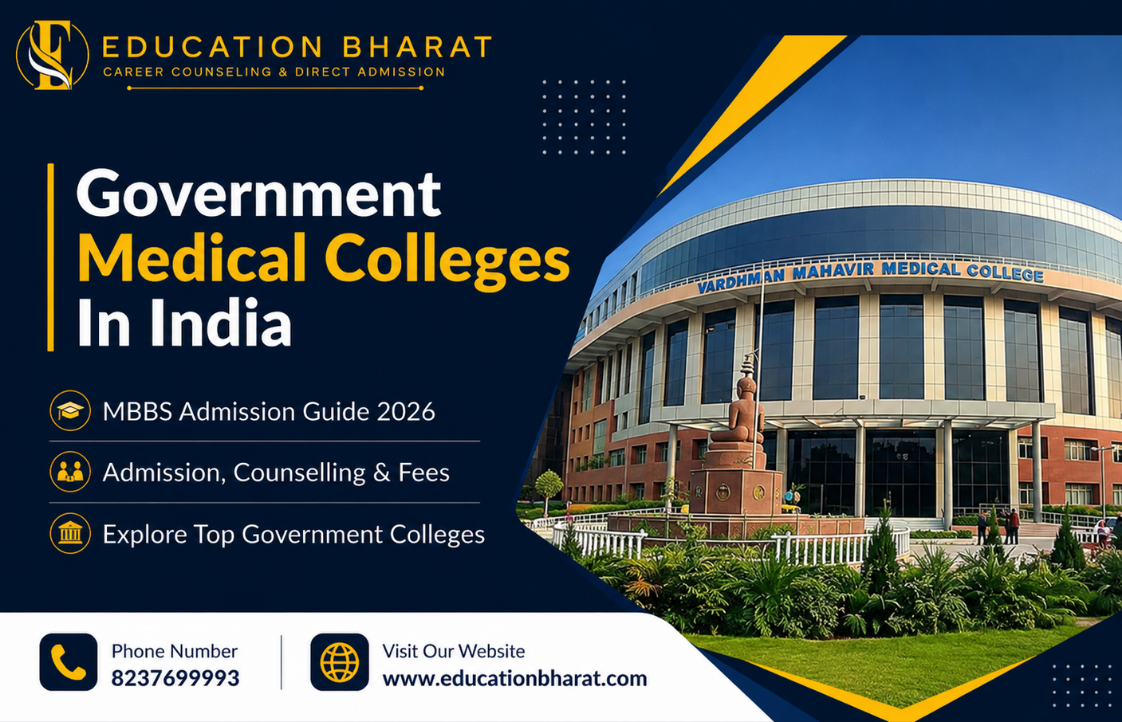
Pursuing an MBBS degree is a dream for thousands of students across India. Every year, lakhs of students appear for the NEET-UG examination with the goal of securing a seat in one of the Government Medical Colleges in India. These colleges are well-known for their affordable fee structure, experienced faculty, excellent clinical exposure, and strong academic reputation. Compared to private medical colleges, government institutions provide high-quality medical education at a much lower cost, making them the preferred choice for most NEET aspirants.
Over the past few years, India has significantly expanded its medical education infrastructure by increasing the number of government medical colleges and MBBS seats. Despite this growth, admission remains highly competitive because seats are allotted strictly on the basis of NEET merit through centralized counselling.
If you are planning to pursue MBBS, this guide will help you understand everything about Government Medical Colleges in India, including eligibility, admission process, counselling, fees, and the factors you should consider before choosing a college.
Why Choose Government Medical Colleges in India?
Choosing the right medical college is one of the most important decisions for every aspiring doctor. Government Colleges in India offer several advantages that make them the first preference among NEET-qualified students.
1. Affordable MBBS Fees
One of the biggest advantages of studying in Government Medical Colleges in India is the low tuition fee. In many states, the annual tuition fee ranges from ₹10,000 to ₹1,50,000, making MBBS education affordable for students from different financial backgrounds.
2. Highly Experienced Faculty
Government medical colleges have experienced professors, senior doctors, and specialists who provide quality education and practical guidance throughout the MBBS course.
3. Excellent Clinical Exposure
Most Government Colleges are attached to large government hospitals that receive thousands of patients every day. Students gain hands-on clinical experience from the early years of their medical education, which helps them develop strong practical skills.
4. Better Return on Investment
Since tuition fees are comparatively lower than private colleges, students graduate with significantly less financial burden while earning a highly respected medical degree.
5. Better Internship Opportunities
Government hospitals provide excellent internship opportunities where students work with experienced doctors and treat a wide variety of medical cases.
6. Research and Academic Growth
Many government medical colleges encourage undergraduate students to participate in medical research projects, conferences, workshops, and healthcare awareness programs.
Latest Overview of Government Medical Colleges in India
Medical education in India continues to grow every year with the addition of new colleges and MBBS seats. The Government of India and the National Medical Commission (NMC) are continuously working to improve healthcare education across the country.
Below is a quick overview:
| Particular | Details |
| Entrance Examination | NEET-UG |
| Admission Mode | AIQ & State Quota Counselling |
| Government Medical Colleges | 450+ |
| Government MBBS Seats | 60,000+ |
| Approval Authority | National Medical Commission (NMC) |
| Course Duration | 5.5 Years (Including Internship) |
The exact number of colleges and seats may change every year as new institutions receive approval.
Eligibility Criteria for Government Medical Colleges in India
Students applying for MBBS admission must satisfy the eligibility criteria prescribed by the National Medical Commission and counselling authorities.
Educational Qualification
Candidates should have passed Class 12 or an equivalent examination with the following subjects:
- Physics
- Chemistry
- Biology/Biotechnology
- English
from a recognized board.
Minimum Qualifying Marks
Students must secure the minimum qualifying marks required under NEET eligibility rules for their respective categories.
Age Requirement
Candidates should have completed the minimum age requirement prescribed for MBBS admission at the time of admission.
NEET Qualification
Admission to Government Medical Colleges in India is strictly based on NEET-UG. Qualifying NEET alone does not guarantee admission. Students must also participate in counselling and secure a seat according to their rank.
How to Get Admission in MBBS in Government Medical College
Many students ask how to get admission in MBBS in government medical college. The admission process is transparent and completely merit-based.
Step 1: Appear for NEET-UG
Every student seeking admission to Government Medical Colleges in India must appear for the National Eligibility cum Entrance Test (NEET-UG).
Step 2: Qualify NEET
Candidates should obtain a competitive NEET score because government medical college seats are limited and highly competitive.
Step 3: Register for Counselling
After the NEET result is declared, eligible candidates must register for counselling.
There are two counselling categories:
- 15% All India Quota (AIQ): Open to eligible candidates across India.
- 85% State Quota: Conducted by individual state authorities for eligible state candidates.
Step 4: Choice Filling
Candidates should carefully research the government medical college list India before selecting their preferred colleges during counselling.
Choosing colleges based on previous year’s cutoffs, location, fees, and available facilities can improve the chances of securing a suitable seat.
Step 5: Seat Allotment
Seats are allotted based on:
- NEET Rank
- Reservation Category
- Seat Availability
- College Preferences
- Counselling Rules
Step 6: Document Verification
Students allotted a seat must report for document verification with all the required original documents.
Step 7: Admission Confirmation
After successful verification and fee payment, admission to the allotted government medical college is confirmed.
Documents Required for MBBS Admission
Candidates should keep the following documents ready before counselling begins:
- NEET Admit Card
- NEET Scorecard
- Class 10 Certificate
- Class 12 Marksheet
- Transfer Certificate
- Migration Certificate (if applicable)
- Aadhaar Card or any valid Photo Identity Proof
- Passport-size Photographs
- Category Certificate (if applicable)
- Domicile Certificate (for State Quota candidates)
- PWD Certificate (if applicable)
Preparing these documents in advance helps students complete the admission process smoothly without unnecessary delays.
Government Medical College List India (State-wise Overview)
If you are searching for a government medical college list India, you will find government medical colleges in almost every state and union territory. These colleges are approved by the National Medical Commission (NMC) and offer MBBS admission through NEET-UG counselling.
Some states have a larger number of government medical colleges due to their higher population and healthcare infrastructure.
| State | Approximate Number of Government Medical Colleges |
| Uttar Pradesh | 45+ |
| Tamil Nadu | 40+ |
| Maharashtra | 35+ |
| Karnataka | 25+ |
| Rajasthan | 30+ |
| Madhya Pradesh | 20+ |
| Gujarat | 25+ |
| West Bengal | 25+ |
| Kerala | 12+ |
| Telangana | 20+ |
| Andhra Pradesh | 18+ |
| Bihar | 15+ |
| Odisha | 12+ |
| Punjab | 8+ |
| Haryana | 8+ |
The number of colleges may increase as new government medical colleges are approved by the National Medical Commission.
Students should always refer to the latest counselling notifications before filling their college preferences.
Top Government Medical Colleges in India
Some institutions have consistently ranked among the best due to their academic excellence, experienced faculty, research opportunities, and patient exposure.
1. AIIMS New Delhi
- One of India’s premier medical institutions
- Excellent research facilities
- Outstanding clinical exposure
- Highly competitive NEET cutoff
2. Maulana Azad Medical College, Delhi
- Affordable MBBS education
- Excellent internship opportunities
- Strong NEET PG performance
3. Madras Medical College, Chennai
- One of India’s oldest medical colleges
- Large teaching hospital
- Strong academic reputation
4. King George’s Medical University (KGMU), Lucknow
- Modern infrastructure
- Excellent faculty
- High patient inflow
5. Grant Medical College, Mumbai
- Historic institution
- Comprehensive clinical training
- Excellent placement opportunities
6. JIPMER Puducherry
- Centrally funded institution
- Advanced research facilities
- Excellent faculty and infrastructure
7. IMS BHU, Varanasi
- Strong academic environment
- Modern medical facilities
- Research-focused education

AIQ vs State Quota: Understanding MBBS Counselling
After qualifying NEET, students participate in counselling under either the All India Quota (AIQ) or the State Quota.
| All India Quota (AIQ) | State Quota |
| 15% Government Seats | 85% Government Seats |
| Conducted by MCC | Conducted by State Authorities |
| Open to eligible candidates across India | Primarily for eligible state candidates |
| National-level competition | State-level competition |
Participating in both counselling processes, if eligible, can improve your chances of securing admission to Government Colleges.
MBBS Fees in Government Medical Colleges in India
One of the biggest advantages of studying in Government Medical Colleges is the affordable fee structure.
| Expense | Approximate Annual Cost |
| Tuition Fee | ₹10,000 – ₹1,50,000 |
| Hostel Fee | ₹5,000 – ₹50,000 |
| Mess Charges | ₹25,000 – ₹60,000 |
| Examination Fee | Varies by College |
| Miscellaneous Expenses | ₹5,000 – ₹20,000 |
Compared to private medical colleges, government colleges provide excellent value for money, allowing students to complete MBBS with significantly lower educational expenses.
Tips to Secure Admission in Government Medical Colleges in India
Admission to Government Medical Colleges in India is highly competitive. Follow these tips to improve your chances:
- Aim for the highest possible NEET score.
- Participate in both AIQ and State Quota counselling whenever eligible.
- Research the government medical college list India before filling choices.
- Fill a sufficient number of realistic college preferences.
- Keep all documents ready before counselling.
- Monitor official counselling notifications regularly.
- Check previous year’s cutoff trends to make informed choices.
Why Choose Education Bharat for MBBS Admission Guidance?
Choosing the right medical college and understanding the counselling process can be overwhelming for many students. Education Bharat provides professional guidance to help students make informed decisions throughout their MBBS admission journey.
Education Bharat assists students by:
- Providing personalized MBBS admission counselling.
- Explaining NEET counselling procedures.
- Helping students understand AIQ and State Quota admissions.
- Assisting with college selection based on rank and preferences.
- Offering guidance on documentation and admission formalities.
- Supporting students throughout the counselling process.
Whether you are looking for information about Government Medical Colleges in India, counselling guidance, or college selection, professional assistance can simplify the admission process and reduce confusion.
Chat on WhatsApp
Frequently Asked Questions (FAQs)
1. How many Government Medical Colleges are there in India?
India has more than 450 Government Medical Colleges, and the number continues to increase as new institutions receive approval.
2. Is NEET compulsory for admission to Government Medical Colleges in India?
Yes. Admission to all government medical colleges is based on the NEET-UG examination.
3. How to get admission in MBBS in government medical college?
Students must qualify NEET, participate in counselling, complete choice filling, undergo document verification, and secure a seat through merit-based allotment.
4. What is the average fee in Government Medical Colleges in India?
The annual tuition fee generally ranges between ₹10,000 and ₹1,50,000 depending on the state and institution.
5. What is the duration of the MBBS course?
The MBBS course duration is 5.5 years, including one year of compulsory rotating internship.
6. What is the difference between AIQ and State Quota?
AIQ includes 15% government seats available at the national level, while State Quota covers 85% of seats managed by individual state counselling authorities.
7. Can I apply for both AIQ and State Quota counselling?
Yes, if you satisfy the eligibility criteria for your state’s counselling, you can participate in both AIQ and State Quota counselling.
8. Which documents are required during counselling?
Important documents include the NEET scorecard, admit card, Class 10 and 12 certificates, identity proof, photographs, category certificate (if applicable), and domicile certificate for state quota admissions.
9. Which are the best Government Medical Colleges in India?
Some of the leading institutions include AIIMS New Delhi, Maulana Azad Medical College, Madras Medical College, Grant Medical College, KGMU Lucknow, JIPMER Puducherry, and IMS BHU.
10. Are Government Medical Colleges better than private medical colleges?
Government medical colleges are generally preferred because of their affordable fees, experienced faculty, excellent patient exposure, and strong academic reputation.
Conclusion
Choosing one of the Government Medical Colleges in India is one of the best decisions for students who wish to pursue an affordable and high-quality MBBS education. With experienced faculty, excellent clinical exposure, well-equipped teaching hospitals, and low tuition fees, these colleges continue to be the first preference for NEET aspirants across the country.
Understanding how to get admission in MBBS in government medical college, researching the latest government medical college list India, and participating in both AIQ and State Quota counselling can significantly improve your chances of securing a seat.
If you need expert guidance throughout the admission process, Education Bharat can help you understand counselling procedures, compare colleges, and make informed decisions based on your NEET rank and career goals.